
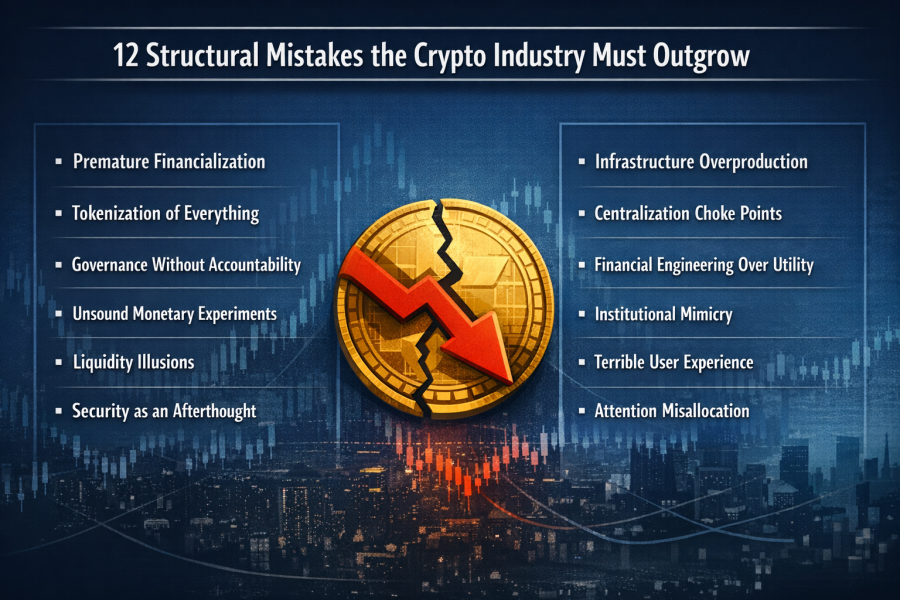
Every transformative technology passes through a chaotic early stage. In the beginning, creativity runs ahead of discipline, incentives are poorly aligned, and experimentation outpaces institutions’ ability to adapt. Excess is almost inevitable. The Internet experienced this in 1999-2000 during its eponymous crash. Railroads did in the nineteenth century. Electricity did in the early twentieth century.
Crypto has been going through its own version of that phase for the past decade, and the crypto industry has faced significant challenges.
Since around 2015, the crypto industry has produced remarkable innovations: decentralized finance, programmable digital assets, global settlement networks, and entirely new models of economic coordination. Yet alongside these breakthroughs, the ecosystem has also accumulated a series of structural aberrations: design mistakes, incentive failures, governance weaknesses, and misplaced priorities.
What we need to see now is not the end of crypto’s trajectory but the beginning of a necessary cleanup phase. Understanding the mistakes of the first decade is essential for building the next one on stronger foundations.
1. Premature Financialization
One of the most consequential distortions in crypto was the inversion of the normal innovation sequence. In most industries, companies build products first, demonstrate adoption, generate revenue, and only then become financialized through markets. Crypto reversed that order. Projects launched tokens before their products existed, often through token generation events designed primarily to raise capital.
This premature financialization led to extreme early-stage valuations, with projects achieving multi-billion-dollar market capitalizations despite minimal usage or revenue. Tokens often became speculative instruments disconnected from real economic activity. Early investors received large allocations, while retail participants frequently became the liquidity that enabled those investors to exit. In many cases, token incentives replaced sustainable business models, with protocols distributing emissions rather than generating real revenue. The result was an ecosystem where speculation often preceded substance.
2. The Tokenization of Everything
The ease of creating tokens led to another widespread mistake: assuming that every product required one. Instead of asking whether a token was economically necessary, many projects simply issued one. Entire micro-economies were constructed around products that did not need them.
This dynamic encouraged copy-paste innovation. Protocols forked existing designs, introduced slight variations, and issued new tokens to capture speculative attention. Memecoins further amplified this trend by attracting large pools of capital despite having little long-term utility. At the same time, airdrop farming became a widespread strategy in which users interacted with protocols primarily to extract future token rewards rather than to use the product itself. When tokens become the central feature of a system rather than a supporting mechanism, innovation becomes distorted.
3. Governance Without Accountability
Crypto promoted decentralization as a defining principle, yet governance structures often lagged behind the rhetoric. Many projects remained heavily dependent on founders or small groups of insiders, even while claiming to be decentralized. In several high-profile cases, unethical executive behavior or conflicts of interest destabilized entire ecosystems.
Decentralized autonomous organizations were intended to provide a new governance model, but in practice, many became exercises in governance theater. Voting power was frequently concentrated among a small number of large token holders, limiting meaningful participation. These experiences revealed that decentralization cannot rely solely on technology; it requires credible institutional design and clear accountability mechanisms.
4. Unsound Monetary Experiments
Crypto’s ambition to redesign money inevitably produced bold experimentation. Some of these experiments proved valuable, but others exposed fundamental flaws in monetary design. Algorithmic stablecoins represented the most visible example.
These systems attempted to maintain price stability through reflexive mint-and-burn mechanisms rather than through collateral or credible reserves. While elegant in theory, they proved fragile in practice. Once market confidence weakened, the same mechanisms designed to maintain stability accelerated collapse. The failures of several algorithmic currencies demonstrated that monetary systems require more than clever code; they require resilience against extreme market conditions.
5. Liquidity Illusions
Liquidity is essential for any financial market, yet much of the liquidity in crypto’s early years was manufactured rather than organic. Protocols frequently relied on liquidity mining programs that paid users to deposit capital through token incentives. In effect, liquidity was rented rather than earned.
This created the appearance of vibrant markets even when the underlying demand was limited. Artificial trading activity and wash trading further inflated volume metrics, giving investors the impression of adoption that did not truly exist. When incentive programs ended, liquidity often disappeared quickly. These dynamics revealed how easily markets can confuse subsidized activity with genuine economic participation.
6. Security as an Afterthought
Blockchain systems are unique in that software directly controls financial assets. Despite this reality, security practices often lag behind the pace of innovation. Many projects prioritized launching quickly rather than rigorously testing their systems.
Smart contracts became increasingly complex as protocols integrated with one another, creating intricate webs of dependencies. This composability amplified the consequences of small errors. Cross-chain bridges introduced another major vulnerability by connecting different blockchain ecosystems through complex mechanisms that proved difficult to secure. The industry also saw the emergence of outright rug pulls, projects designed primarily to extract liquidity before disappearing. These episodes highlighted the need for stronger engineering discipline and security-first design.
7. Infrastructure Overproduction
Crypto devoted enormous energy to infrastructure competition. Dozens of blockchains emerged, each claiming superior speed, scalability, or architectural elegance. Layer-2 systems, sidechains, and modular architectures multiplied rapidly.
While experimentation is valuable, the sheer volume of competing infrastructure fragmented liquidity and attention. In many cases, infrastructure development advanced faster than application demand. The ecosystem ended up with more blockchains than meaningful products running on them. Historically, successful technology ecosystems evolve in the opposite direction: applications drive infrastructure development, not the other way around.
8. Centralization Where It Matters Most
Even as crypto celebrated decentralization, critical parts of the ecosystem remained centralized. Exchanges became dominant custodians of digital assets and served as primary liquidity hubs. This concentration created systemic risks.
When large exchanges collapsed or mismanaged funds, the consequences rippled across the entire market. These events demonstrated that decentralization must extend beyond the protocol layer to include custody, liquidity, and key infrastructure services. Otherwise, the system retains the same vulnerabilities it was meant to eliminate.
9. Financial Engineering Over Real Utility
Another defining characteristic of the early crypto ecosystem was its emphasis on financial engineering. The industry excelled at creating new yield mechanisms, derivatives, and synthetic financial structures. These innovations pushed the boundaries of programmable finance.
However, the focus on financial experimentation often overshadowed the development of products solving real-world problems. Speculation dominated attention and capital allocation. Many projects optimized for trading activity rather than long-term utility. As a result, crypto became heavily financialized before its broader economic applications had time to mature.
10. Institutional Mimicry
Traditional financial institutions increasingly explored blockchain technology, but many of their implementations replicated existing systems rather than embracing the openness of decentralized networks. These initiatives often attempted to reproduce aspects of decentralized finance while removing the transparency and composability that made DeFi transformative.
The result was a form of institutional mimicry: blockchain infrastructure operating inside closed environments controlled by established intermediaries. While such systems may improve efficiency in certain contexts, they rarely capture the deeper promise of open, permissionless financial networks.
11. Terrible User Experience
Despite technological progress, crypto products remain difficult for ordinary users to navigate. Managing private keys, understanding gas fees, bridging assets across chains, and interacting with unfamiliar wallet interfaces create significant friction.
Many products were designed primarily by engineers for technically sophisticated users. For mainstream audiences, the experience remains fragile and confusing. Until usability improves dramatically, the full potential of blockchain technology will remain inaccessible to most people.
12. Attention Misallocation
Perhaps the most subtle but powerful problem has been how the industry allocates its attention. Large portions of crypto’s energy have been consumed by short-term trading narratives, infrastructure rivalries, and speculative cycles.
Meanwhile, the deeper potential of blockchain technology,- trust services, programmable agreements, decentralized coordination, innovative business models, has often received less sustained focus. Innovation requires attention, and speculation tends to redirect attention away from long-term building.
The Beginning of Maturity?
Despite these mistakes, the crypto experiment is beginning to produce foundational breakthroughs. Decentralized finance works. Programmable digital assets exist. Real-world assets are being tokenized and traded. Global, permissionless settlement networks operate every day.
The cleanup phase now underway does not represent failure. It represents maturation. But it must accelerate, so we can leave these bad habits way behind in the rear-view mirror. Every transformative technology passes through a similar stage where early excess gives way to structural discipline.
The next era of crypto will likely look different from the first. I hope there will be fewer tokens, fewer speculative experiments, stronger security standards, and more emphasis on real-life utility. Projects will be judged less by narrative momentum and more by adoption, resilience, and economic sustainability.
The infrastructure built during crypto’s chaotic first decade remains intact. What must come next is the careful process of refining it, keeping what works, discarding what does not, and building systems capable of lasting far beyond the speculative cycles that defined the beginning.